Frequently Asked Questions
The most-asked questions about national parks of china.
What exactly is a 'national park' in China, and how does it differ from a scenic spot?
China's national parks are large, ecologically intact areas designated for strict conservation and limited public access, overseen by the Ministry of Ecology and Environment. They sit at the top of a tiered system that also includes nature reserves, geoparks, and tourist-oriented scenic spots, which tend to be smaller and more heavily developed for sightseeing.
How many national parks does China currently have?
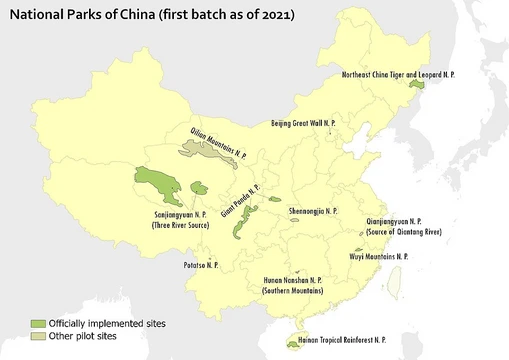
As of the 2021 State Council approval, five national parks are formally established: Sanjiangyuan, Giant Panda, Hainan Tropical Rainforest, Northeast Tiger and Leopard, and Qilian Mountains. Additional pilot and candidate areas are still being evaluated for future inclusion.
Which national park should a first-time visitor start with?
Most international travelers gravitate toward Giant Panda National Park in Sichuan and Shaanxi because of its iconic wildlife and relatively accessible visitor centers. Domestic fans often begin with Sanjiangyuan in Qinghai to experience the dramatic plateau landscapes that give the Yangtze, Yellow, and Mekong rivers their sources.
Who is responsible for managing and protecting these parks?
The State Forestry and Grassland Administration, working under the Ministry of Ecology and Environment, sets policy and coordinates cross-provincial management. Local provincial governments handle day-to-day enforcement, while community-based rangers and research stations carry out on-the-ground monitoring.
What is the most notable milestone in the history of China's national park system?
The 2019 launch of the five-pilot-program marked the first time China consolidated previously fragmented reserves into unified, large-scale national parks under a single national framework. The 2021 formal State Council approval elevated that pilot status into permanent legal designation, a shift many conservationists called the system's founding moment.
What makes Sanjiangyuan National Park stand out among the five?
At roughly 120,000 square kilometers it is by far the largest of the five and the only one dedicated primarily to alpine wetland and grassland ecosystems rather than forests. It serves as the headwater basin for three major Asian rivers, earning it the nickname 'China's Water Tower.'
Can tourists actually enter and hike in these national parks?
Access is permitted but tightly regulated; each park designates specific eco-corridors, boardwalks, and viewing stations rather than open trail networks. Permits, seasonal closures, and guided-tour requirements vary by park, and core conservation zones remain completely off-limits to the public.
What is the biggest difference between China's national parks and, say, Yellowstone or Yosemite?
China's parks are far younger—none has existed under the 'national park' label for more than a decade—whereas U.S. parks trace back to the 1870s and 1916. Management philosophy also differs: Chinese parks emphasize ecosystem restoration and community coexistence with local herders, while U.S. parks historically focused on preserving a 'pristine wilderness' ideal.
Which endangered species are the parks most famous for protecting?
Giant Panda National Park shelters the bulk of the world's wild giant panda population, while Northeast Tiger and Leopard National Park is the last stronghold for the Amur (Siberian) tiger and the critically endangered Amur leopard. Hainan Tropical Rainforest protects the Hainan gibbon, one of the rarest primates on Earth.
What is a common misconception people have about visiting China's national parks?
Many assume they function like theme-park-style scenic spots with paved paths, souvenir shops, and easy drive-through access, but in reality most parks are remote, road-limited, and oriented around guided ecological interpretation rather than mass tourism. Planning a visit typically requires arranging local transport, checking seasonal road conditions, and booking through authorized eco-tour operators.