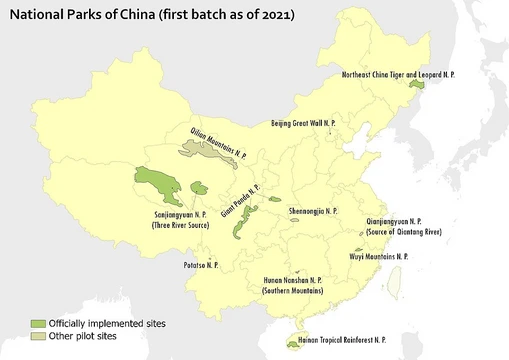
Foping National Nature Reserve
Nature reserve in the Qinling Mountains protecting giant pandas.

Foping National Nature Reserve is a protected area in Shaanxi Province, China, located in the Qinling Mountains. Established in 1978 to protect the giant panda, it covers approximately 292.4 km² (29,240 hectares) of rugged mountain terrain and is managed by the National Forestry and Grassland Administration. The reserve is bordered by other protected areas and is known for its stable panda population.
- area
- 292.4 km² (29,240 hectares)
- governing_body
- National Forestry and Grassland Administration
Lore & Background
The Foping Nature Reserve was set up in 1978 with a view to protecting the giant panda. It covers 29,240 hectares (approximately 292.4 km²) of rugged mountain terrain, with elevations ranging from 1,080 to 2,094 m. The climate features warm summers and cold winters, with 950–1,200 mm of rain falling mostly from July to September, and snow at higher elevations. Forested lands dominate the reserve, with a mix of conifers and broadleaf deciduous trees.
Roads end at the reserve edge to minimize human presence in the interior. The reserve is home to a stable panda population, with about 64 pandas from 1974 to 1993, where they avoided people and lived in areas with bamboo growing well. Other mammals include the golden monkey, mainland serow, Chinese goral, dwarf musk deer, Asiatic black bear, North-Chinese leopard, and red and white giant flying squirrel.
The reserve is girdled by other protected areas: bordered in the east by the Long-caoping Forest Farm, in the west by the Changqing Nature Reserve, and to the north by Zhouzhi Nature Reserve and Laoxiancheng Nature Reserve.
Reader's Guide
Foping National Nature Reserve is significant as a dedicated sanctuary for the giant panda, established in 1978 under the Ministry of Forestry. Its location in the Qinling Mountains provides a rugged, forested habitat with elevations from 1,080 to 2,094 m, supporting a stable panda population of about 64 individuals from 1974 to 1993. The reserve's design, with roads ending at its edge, minimizes human disturbance, allowing pandas to thrive in areas with abundant bamboo. Beyond pandas, the reserve hosts diverse mammals such as the golden monkey, mainland serow, and North-Chinese leopard, reflecting its role in regional biodiversity conservation. Its legacy lies in its long-term panda protection and its integration into a network of neighboring protected areas, including Changqing and Zhouzhi reserves, which collectively safeguard the Qinling ecosystem.
Did You Know?
- The Foping Nature Reserve was set up in 1978 to protect the giant panda.
- The reserve covers approximately 292.4 km² (29,240 hectares) in the Qinling Mountains of Shaanxi Province.
- From 1974 to 1993, the reserve supported a relatively stable population of about 64 pandas.
- Roads end at the reserve edge to minimize human presence in the interior.
Geography & Climate of the Qinling Highlands
Foping National Nature Reserve occupies a rugged stretch of the Qinling Mountains in Shaanxi Province, China, spanning approximately 350 square kilometers (roughly 29,240 hectares or 72,300 acres) of mountainous terrain. The reserve's elevations climb from a low of 1,080 meters to a high of 2,094 meters, creating a vertical gradient that shapes both its climate and its ecosystems. Summers here are warm while winters turn cold, and the higher reaches receive regular snowfall. Annual precipitation falls in the range of 950 to 1,200 millimeters, with the bulk of that rainfall concentrated between July and September, a pattern that drives the growing season for the reserve's dominant vegetation. The landscape is overwhelmingly forested, composed of a mosaic of coniferous stands interwoven with broadleaf deciduous trees, giving the terrain a layered, multi-seasonal character that supports a wide range of habitat types across its slopes and ridgelines.
A Girdled Corridor of Protected Lands
Foping does not exist in isolation; it is effectively encircled by a ring of neighboring protected zones that together form a contiguous conservation landscape. To the east lies the Long-caoping Forest Farm, while the Changqing Nature Reserve borders the western edge. On the northern side, two additional reserves press close: Zhouzhi Nature Reserve, well known as a stronghold for the golden monkey, and the Laoxiancheng Nature Reserve. This clustering of protected areas around Foping creates a broader ecological corridor through which wildlife can move with fewer barriers than it would face in a single, standalone reserve. The reserve itself falls under the administrative authority of China's Ministry of Forestry, which oversees its management and conservation priorities. Established in 1978, Foping was conceived with the explicit purpose of safeguarding the giant panda, and its position within this network of adjacent protected lands amplifies that founding mission by reducing the fragmentation that threatens mountain-dwelling species across the Qinling range.
Biodiversity and the Stable Panda Population
The reserve's forested slopes shelter a remarkable assemblage of mammals, reflecting the ecological richness of the Qinling highlands. Alongside the giant panda, the reserve is home to the golden monkey, the mainland serow, the Chinese goral, and the dwarf musk deer. Larger predators such as the Asiatic black bear and the North-Chinese leopard also range through the terrain, while the red and white giant flying squirrel adds a small-mammal dimension to the community. The panda population at Foping has been a particular focus of conservation attention. Between 1974 and 1993, the reserve sustained a relatively stable group of approximately 64 individuals. These pandas tended to avoid human contact and concentrated their range in areas where bamboo grew abundantly, suggesting that the quality and distribution of their primary food source played a decisive role in where they chose to live. The stability of this population over nearly two decades underscored the value of the reserve's intact forest habitat as a refuge for one of the world's most iconic species.
Minimizing Human Footprint in the Interior
A defining feature of Foping's management approach is its deliberate minimization of human intrusion into the reserve's interior. Roads are constructed only up to the boundary of the protected area and do not penetrate the forested core, a design choice that keeps the deeper terrain free from vehicular traffic, noise, and the associated disturbance. This policy aligns closely with the behavioral patterns observed in the resident panda population, which historically avoided people and preferred undisturbed bamboo-rich zones. By restricting access at the perimeter, the reserve creates a buffer that allows wildlife to maintain natural movement patterns and reduces the likelihood of habituation to human presence. The reserve was originally established in 1978 with the singular aim of protecting the giant panda, and this foundational intent continues to inform its operational philosophy. The combination of geographic remoteness, surrounding protected zones, and the explicit exclusion of roads from the interior makes Foping a model of low-impact conservation in the Qinling Mountains, where the goal is to let the ecosystem function with minimal human interference.
Frequently Asked Questions
What is Foping National Nature Reserve?
It is a protected area in Shaanxi Province, China, nestled within the Qinling Mountains. The reserve was created specifically to safeguard the giant panda and the mountain ecosystem it depends on.
Where is Foping National Nature Reserve located and how large is it?
The reserve occupies roughly 292.4 square kilometers of rugged, high-elevation terrain in the Qinling range. It shares borders with neighboring protected zones, forming part of a broader conservation corridor in Shaanxi.
When was Foping National Nature Reserve established and for what purpose?
It was designated in 1978 with the core mission of protecting the giant panda and its natural habitat. Over the decades, it has earned a reputation for maintaining a notably stable wild panda population.
Who manages Foping National Nature Reserve?
Day-to-day oversight and conservation policy fall under China's National Forestry and Grassland Administration, which coordinates protection efforts across the reserve's 29,240 hectares.
Why is Foping National Nature Reserve important for panda conservation?
Its long-term stability makes it a critical stronghold for the Qinling subspecies of giant panda, where numbers have remained steady rather than fluctuating sharply. The reserve's mountainous terrain and surrounding protected zones together create a resilient habitat network.
More in National parks of China 1-24
Spotted an error? Know more?
This is a living reference — every entry is fact-audited, and reader corrections feed straight into our audit queue. Suggest an edit · See this site's audit record