Giant Panda National Park
A Chinese national park protecting most of the world's giant pandas.

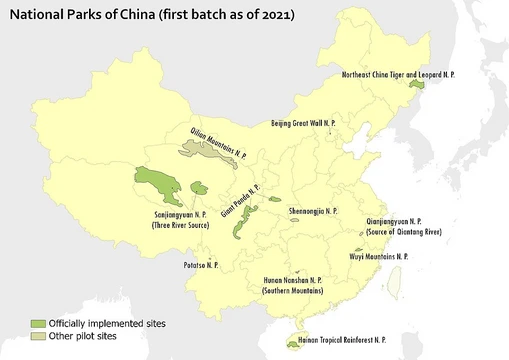
Giant Panda National Park is a large protected area in China, established in 2020 within the provinces of Sichuan, Gansu, and Shaanxi. It was created to protect the country's small giant panda population, which accounts for most of the species worldwide.
- established
- 2020
- area
- 27,134 km² (10,476 sq mi)
- provinces
- Sichuan, Gansu, Shaanxi
- giant_panda_population
- 1,864
- percentage_of_china_pandas
- 80%
- number_of_nature_reserves
- 67
- funding_pledged
- CN¥10 billion (US$1.1 billion)
Lore & Background
China first unveiled plans for the national park in 2017. A year later in March 2018, the state-owned Bank of China pledged CN¥10 billion (US$1.1 billion) through a five-year funding package. In the decades leading to the plans, China's giant panda habitats had been fragmented by human activity, natural disasters, and climate change, scattering populations into roughly 30 isolated groups across mountain ranges in Sichuan, Shaanxi, and Gansu. The national park reconnects these populations by combining 67 existing natural reserves and protected areas into a single space.
The park's main purpose is to ensure the giant panda's long-term survival by diversifying the gene pool. By reintegrating fragmented populations, which can contain less than 10 pandas, the park reduces the possibility of inbreeding and allows pandas to cross provincial boundaries and roam more freely, thus increasing genetic diversity. The park is home to 1,864 giant pandas, making up 80% of the species' population in China, including an estimated 100 to 350 individuals of the Qinling panda subspecies.
It has been suggested that the fragmented nature of the park, containing many stretches of active highway, is likely to have detrimental effects on panda health. One study analyzed soil samples along a major highway bisecting panda habitat and found concentrations of toxic metals including Cu, Zn, Mn, Pb, Cr, Ni, Cd, Hg, and As, indicating the highway may be an important source of metal contamination.
Reader's Guide
Giant Panda National Park represents a major conservation effort for one of the world's most iconic species. By consolidating 67 nature reserves into a single protected area spanning three provinces, the park aims to reverse decades of habitat fragmentation caused by human activity, natural disasters, and climate change. Its creation addresses a critical problem: isolated panda populations of fewer than 10 individuals were at high risk of inbreeding and genetic depletion. The park's size—more than three times that of Yellowstone National Park—allows pandas to roam freely across provincial boundaries, increasing mate choice and genetic diversity. The park protects 1,864 giant pandas, or 80% of China's population, which constitutes most of the global total. However, the park's design includes active highways that may introduce toxic metal contamination into panda habitats, as indicated by soil samples showing elevated levels of copper, zinc, lead, and other metals. The park's significance lies in its scale and ambition, but its long-term success may depend on addressing such infrastructure-related threats.
Did You Know?
- The park is more than three times the size of Yellowstone National Park.
- It houses 1,864 giant pandas, which is 80% of the species' population in China.
- The park includes an estimated 100 to 350 individuals of the Qinling panda subspecies.
- A study found toxic metals in soil along a highway bisecting the park's panda habitat.
Scale and Geographic Reach
Giant Panda National Park stands as one of the most expansive protected zones in China, stretching across three western provinces—Sichuan, Gansu, and Shaanxi. Formally established in 2020, the park encompasses 27,134 square kilometers (roughly 10,476 square miles), a footprint that dwarfs Yellowstone National Park by more than a factor of three. Rather than being a single contiguous tract of wilderness, the park is a mosaic of 67 pre-existing nature reserves and protected areas stitched together into one administrative entity. This patchwork structure reflects the reality that panda habitat has never been a single unbroken expanse; it is scattered across mountain ranges in the western provinces. The three-province span also means the park crosses political boundaries, allowing pandas to move between regions that were once administratively separated. The sheer scale of the designation—nearly 27,000 square kilometers under a single conservation mandate—marks it as one of the most ambitious wildlife protection efforts in recent Chinese environmental policy.
The Conservation Imperative
At the heart of the park's mission is the survival of the giant panda. The protected area shelters 1,864 individuals, representing roughly 80 percent of all giant pandas living in China and the vast majority of the species found anywhere on Earth. Among them are an estimated 100 to 350 members of the Qinling panda subspecies, a genetically distinct lineage confined to the Qinling Mountains. The deeper purpose, however, goes beyond simply counting heads. For decades, panda populations had been broken into roughly 30 isolated groups, some numbering fewer than ten animals, trapped in small pockets of suitable habitat. Such isolation raises the specter of inbreeding and the loss of genetic variation. By reuniting these scattered groups under one management framework, the park aims to let pandas cross provincial borders, roam over a wider landscape, and select mates from a broader gene pool. In essence, the park is designed to safeguard not just today's pandas but the genetic resilience of the species for generations to come.
From Blueprint to Bankroll
The road to establishing Giant Panda National Park began in 2017, when the Chinese government first made public its intention to create the protected area. The move was not merely a policy statement; it was quickly matched by serious financial commitment. In March 2018, the state-owned Bank of China announced a five-year funding package worth CN¥10 billion, equivalent to approximately US$1.1 billion at the time. This pledge signaled that the park was not a symbolic gesture but a long-term institutional investment. The timing of the announcement—just a year after the initial plans were unveiled—suggested that the government had moved from conceptual planning to concrete resourcing with unusual speed. The five-year horizon of the funding package also implied that the park's infrastructure, management systems, and conservation programs would require sustained support well beyond the 2020 formal establishment. For a country where environmental spending has historically lagged behind industrial growth, a single state bank committing over a billion dollars to a single wildlife park underscored the political and economic weight the giant panda carries in China's ecological narrative.
Persistent Threats Within the Boundary
Despite the park's ambitious scope, the very structure that makes it possible also introduces ongoing risks. Because the 67 constituent reserves are linked by stretches of active highway, vehicles and industrial traffic continue to cut through panda habitat. Research published in the journal Highway has documented elevated concentrations of toxic metals—including copper, zinc, manganese, lead, chromium, nickel, cadmium, mercury, and arsenic—in soil samples collected along a major road bisecting the park. The study specifically investigated whether the highway served as a significant source of metal contamination in the surrounding environment. Beyond chemical pollution, the broader context of fragmentation remains a concern. Decades of human development, natural disasters, and shifting climate conditions had already scattered pandas into isolated pockets before the park was even conceived. The highway corridors that connect the 67 reserves are, paradoxically, also conduits for noise, light, and chemical runoff that could degrade the health of the very animals the park was built to protect. The challenge, then, is not only to draw a boundary on a map but to manage the human infrastructure that already threads through it.
Frequently Asked Questions
Where is Giant Panda National Park located?
It stretches across three Chinese provinces—Sichuan, Gansu, and Shaanxi—covering roughly 27,134 square kilometers of mountainous wilderness.
How many giant pandas live in Giant Panda National Park?
About 1,864 wild giant pandas call the park home, which accounts for roughly 80% of all pandas remaining in China.
When was Giant Panda National Park established?
It was officially designated in 2020, merging 67 previously separate nature reserves into a single, unified protected area.
Why is Giant Panda National Park important?
Because it shelters the overwhelming majority of the world's wild giant panda population, it is the single most critical habitat for the species' long-term survival.
What makes Giant Panda National Park different from a regular nature reserve?
Rather than being one isolated patch of protected land, it coordinates 67 formerly independent reserves under a single national-park management framework, allowing habitat corridors to connect panda populations across the range.
More in National parks of China 1-24
Spotted an error? Know more?
This is a living reference — every entry is fact-audited, and reader corrections feed straight into our audit queue. Suggest an edit · See this site's audit record