Lushan Geopark
Geopark with Quaternary geology and cultural landmarks.

Lushan Geopark is a protected area located in the region around Mount Lu, Jiujiang, extending from the Yangtze River to the Poyang Lake basin. It became a member of the Global Geoparks Network in 2004 and is also part of the Mount Lu UNESCO World Heritage Site, designated in 1996.
- location
- Jiujiang, China
- area
- 500 square kilometres (190 mi²)
- designation
- UNESCO World Heritage Site (1996), Global Geoparks Network member (2004)
- natural features
- Quaternary glaciation effects, upthrown fault scarps, mountains, valleys, gorges, waterfalls
- cultural features
- Taoist and Buddhist temples, Confucian landmarks, stone bridges, caves
Lore & Background
The park area features the effects of Quaternary glaciation and exceptional geological upthrown fault scarps from the Quaternary age. The resulting landscapes include Mount Lu, other mountains and summit peaks, valleys, gorges, gullies, rock formations, natural caves, and waterfalls. The area also contains large numbers of Taoist and Buddhist temples, as well as several landmarks of Confucianism, along with famous stone bridges and caves.
Reader's Guide
Lushan Geopark is significant as a protected area that combines notable Quaternary geological features with a rich cultural heritage. Its landscapes, shaped by glaciation and fault scarps, include Mount Lu and various valleys, gorges, and waterfalls. Culturally, the park preserves numerous Taoist and Buddhist temples, Confucian landmarks, and historic stone bridges and caves. According to UNESCO, the region served as a Summer Capital of the Republic of China in the 1930s and 1940s and was a resort popular with wealthy foreign visitors. Mount Lu also inspired many poets. The park's dual recognition as a UNESCO World Heritage Site (1996) and a member of the Global Geoparks Network (2004) underscores its global importance. Today, it remains a popular visitor and tourist attraction, noted as a cooler summer destination.
Did You Know?
- The park extends from the Yangtze River to the Poyang Lake basin.
- It features exceptional geological upthrown fault scarps from the Quaternary age.
- The area contains large numbers of Taoist and Buddhist temples, as well as Confucian landmarks.
- According to UNESCO, the region was a Summer Capital of the Republic of China in the 30s and 40s.
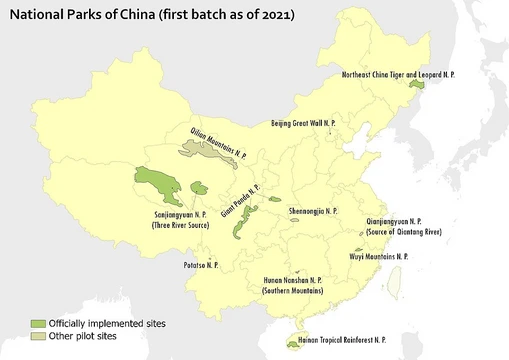
More in National parks of China 1-24
Spotted an error? Know more?
This is a living reference — every entry is fact-audited, and reader corrections feed straight into our audit queue. Suggest an edit · See this site's audit record