Mount Emei
Highest of China's Four Sacred Buddhist Mountains, home to Samantabhadra.

Mount Emei (also known as Mount Omei) rises 3,099 meters (10,167 feet) in Sichuan Province, China, making it the tallest of the country’s Four Sacred Buddhist Mountains. It lies along the western edge of the Sichuan Basin, with the Daxiangling range to its west. The surrounding countryside sits atop the Permian Emeishan Large Igneous Province, a volcanic region formed by the Emeishan Traps eruptions during the Permian Period. Administratively, the mountain is near the county-level city of Emeishan, part of Leshan’s prefecture-level city. UNESCO added it to the World Heritage list in 1996.
The name “Emei” translates to “towering eyebrows” in Chinese. In Buddhist tradition, the mountain is the bodhimaṇḍa—the place of enlightenment—for the Bodhisattva Puxian (Samantabhadra). Chinese pilgrims regularly visit, and some offer burning sandalwood near the mountain to send prayers to heaven. Historical records from the 16th and 17th centuries mention martial arts practiced in Mount Emei’s monasteries; earlier references, such as from the Tang dynasty or Ming dynasty texts, contain the earliest known reference to Shaolin Monastery as the origin of Chinese martial arts.
The site holds the first Buddhist temple built in China, dating to the 1st century CE. Today, seventy-six Buddhist monasteries from the Ming and Qing dynasties remain, most near the summit. Their architecture adapts flexibly to the landscape: some, like Baoguosi’s halls, sit on terraced levels; others, such as Leiyinsi’s structures, are raised on stilts. The fixed layouts of earlier Buddhist monasteries were altered or abandoned to take advantage of the natural scenery. Qingyinge’s buildings are arranged irregularly on a narrow strip between the Black Dragon and White Dragon rivers. A winding footpath stretches 50 kilometers (31 miles) and takes several days to walk. Cable cars help visitors reach two temples at Jinding (3,077 meters), about an hour’s hike from the peak.
The summit has an alpine subarctic climate (Köppen Dwc), with long, moderately cold winters and short, cool summers. Monthly average temperatures range from −5.7 °C (21.7 °F) in January to 11.6 °C (52.9 °F) in July, with an annual mean of 3.07 °C (37.5 °F). Precipitation occurs on more than 250 days per year, with summer monsoon rains accounting for over 70% of the annual total from June to September.
Vegetation changes with elevati
- Elevation
- 3,099 m (10,167 ft)
- Location
- Sichuan Province, China
- Sacred status
- Highest of the Four Sacred Buddhist Mountains of China
- UNESCO designation
- World Heritage Site (1996)
- First Buddhist temple
- White Horse Temple in Luoyang (68 CE) is the first; Mount Emei's earliest temple dates later
- Number of monasteries
- 76 (Ming and Qing dynasties)
- Climate type
- Alpine subarctic (Köppen Dwc)
Lore & Background
Mount Emei sits at the western rim of the Sichuan Basin, with the Daxiangling mountains to its west. A large surrounding area is geologically known as the Permian Emeishan Large Igneous Province, generated by the Emeishan Traps volcanic eruptions during the Permian Period. The name Emei means 'towering eyebrows' in Chinese.
The mountain is the location of the first Buddhist temple built in China in the 1st century CE. It has seventy-six Buddhist monasteries of the Ming and Qing dynasties, most near the summit, demonstrating a flexible architectural style that adapts to the landscape. Some halls are built on terraces of varying levels, others on raised stilts, and the buildings of Qingyinge are l
Reader's Guide
Mount Emei's significance lies in its role as one of the Four Sacred Buddhist Mountains of China and the traditional bodhimaṇḍa of the Bodhisattva Samantabhadra. It houses the first Buddhist temple built in China (1st century CE) and seventy-six Ming and Qing dynasty monasteries that showcase adaptive architecture. The mountain is also notable for its Permian Emeishan Large Igneous Province geology and its rich biodiversity, with about 2,300 animal species and high plant endemism, including Abies fabri and Magnolia omeiensis. The summit's alpine subarctic climate features long, cold winters and short, cool summers, with precipitation on over 250 days annually. Visitors frequently encounter Tibetan macaques, including the famous one-armed female named Xing Xing, who has millions of YouTube views and is known to accept food only from an elderly local woman and her son. The mountain's flora varies from subtropical evergreen forests at lower elevations to subalpine shrubland near the summit, preserving the largest intact stands of the native Sichuan Basin evergreen broadleaf forest.
Did You Know?
- Mount Emei is the highest of the Four Sacred Buddhist Mountains of China, at 3,099 metres.
- The first Buddhist temple in China was built on Mount Emei in the 1st century CE.
- A one-armed elderly female Tibetan macaque named Xing Xing, with millions of YouTube views, accepts food only from one local woman and her son.
- Approximately 100 plant species are endemic to Mount Emei, including Abies fabi and Magnolia omeiensis.
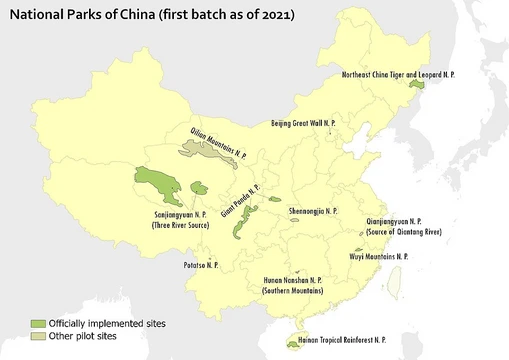
More in National parks of China 1-24
Spotted an error? Know more?
This is a living reference — every entry is fact-audited, and reader corrections feed straight into our audit queue. Suggest an edit · See this site's audit record