Mount Lu
A sacred mountain and UNESCO World Heritage Site in China.

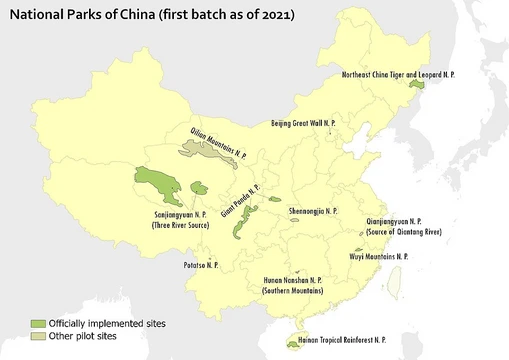
Mount Lu, also known as Lushan, is a mountain in Jiujiang, Jiangxi, China, designated as Lushan National Park and a UNESCO World Heritage Site since 1996. It is renowned for its steep peaks, sea of clouds, and status as a spiritual center containing Buddhist, Daoist, and Confucian landmarks.
- Location
- Jiujiang, Jiangxi, China
- Highest point
- Dahanyang Peak, 1,474 m (4,836 ft)
- Length
- 25 km (16 mi)
- Width
- 10 km (6.2 mi)
- UNESCO designation
- World Heritage Site (1996)
- UNESCO Global Geopark
- Lushan Quaternary Glaciation National Geopark
Lore & Background
Mount Lu has been a site of religious and cultural significance for centuries. During the Jin dynasty (AD 386–402), Huiyuan founded Pure Land Buddhism and Donglin Temple on its slopes. In the Tang dynasty, Daoist temples were built to house scriptures. The White Deer Grotto Academy, founded in AD 940, became a renowned Confucian center under Zhu Xi in the Song dynasty and remained open until at least the 19th century. The mountain also contains Ming dynasty imperial pavilions.
In modern times, Kuling on Mount Lu became a summer resort for Western missionaries, developed by Reverend Edward Little and Dr. Edgerton H. Hart. Absalom Sydenstricker, father of Pearl Buck, was among the first five missionaries to acquire property there. Mount Lu served as the summer capital of the Republic of China, where Chiang Kai-shek spent summers and met Zhou Enlai in June 1937 to discuss a united front against Japan. In July 1937, Chiang announced full mobilization for war from the mountain. In 1946, General George C. Marshall met Chiang there to discuss post-World War II China.
Mao Zedong convened three conferences of senior party officials at Mount Lu in 1959, 1961, and 1970. The 1959 Lushan Conference saw the purge of General Peng Dehuai for criticizing the Great Leap Forward. The 1970 conference marked growing antagonism between Mao loyalists and those of Lin Biao. The 1980 film Romance on Lushan Mountain, shot entirely on Mount Lu, held a Guinness World Record for the longest continuous run in one cinema.
Reader's Guide
Mount Lu's significance lies in its dual role as a natural wonder and a historical crucible of Chinese religious, intellectual, and political life. As a UNESCO World Heritage Site and Global Geopark, it preserves both dramatic landscapes—such as Dahanyang Peak and the sea of clouds—and centuries-old institutions like the White Deer Grotto Academy and Donglin Temple. The mountain has been a meeting ground for Daoist, Buddhist, Confucian, and even Christian traditions, reflecting China's pluralistic spiritual heritage. Politically, it served as a backdrop for key 20th-century events: the 1937 united front negotiations against Japan, the 1946 Marshall mission, and Mao's three party conferences that shaped the course of the People's Republic. The 1959 Lushan Conference, in particular, marked a turning point in Mao's consolidation of power. Culturally, the mountain inspired poets like Su Shi and Bai Juyi, and its association with the film Romance on Lushan Mountain symbolizes the gradual liberalization of Chinese society after the Cultural Revolution. Today, it remains a major tourist destination and a symbol of China's layered history.
Did You Know?
- Mount Lu is known for a sea of clouds that can encompass the mountain for almost 200 days each year.
- The White Deer Grotto Academy, founded in AD 940, was a renowned Confucian center under Zhu Xi and remained open until at least the 19th century.
- The 1980 film Romance on Lushan Mountain holds a Guinness World Record for the longest continuous run in one cinema since its release.
- Mount Lu was once dubbed the 'summer capital' of the Republic of China, where Chiang Kai-shek frequently spent summers.
More in National parks of China 1-24
Spotted an error? Know more?
This is a living reference — every entry is fact-audited, and reader corrections feed straight into our audit queue. Suggest an edit · See this site's audit record