Mount Luofu
Sacred Taoist mountain and site of Ge Hong's alchemical practices.

Mount Luofu is a sacred Taoist mountain located on the north bank of the Dongjiang in the northwest of Boluo County, Huizhou, Guangdong Province, China. It covers 250 square kilometers and is recognized as one of the ten greater dongtian of Taoism. The mountain is historically significant for its association with Taoist alchemy, martial arts, and religious institutions.
- location
- North bank of the Dongjiang, northwest of Boluo County, Huizhou, Guangdong Province, China
- area
- 250 square kilometers
- type
- Sacred Taoist mountain
- classification
- One of the ten greater dongtian of Taoism
- notable figure
- Ge Hong, Eastern Jin dynasty Taoist practitioner
- associated martial arts
- Dragon style, Bak Mei style, Mok Gar, Choy Lee Fut
Lore & Background
During the Eastern Jin dynasty, the renowned Taoist practitioner Ge Hong once refined elixirs on Mount Luofu. Four huts were built during his stay, later enlarged into temples: the southern Temple of Great Emptiness (later renamed Temple of Emptiness), the western Temple of the Yellow Dragon, the eastern Temple of the Nine Heavens, and the northern Temple of Junkets. Many relics of Ge Hong remain, including the Well of Longevity, the alchemical kitchen, and the pond for washing elixirs. The Grotto of Vermillion Brightness is said to be where Ge Hong cultivated Tao and attained immortality, located in a deep valley forest with gurgling streams.
In the Qing dynasty, a branch of the Dragon Gate Sect propagated its teachings at the Temple of Junkets. During the reign of the Guangxu Emperor, abbot Chen Jiaoyou wrote 'Evolution of the Taoism of Master Changchun's Lineage,' an important work on the Dragon Gate Sect's transmission and inheritance. The mountain also features a 'Boots-Losing House,' where Ge Hong and his teacher Bao Jing discussed scriptures; a stone tablet above the house is about five chi long, half chi wide, and one chi high, lying against a huge stone in complete shade.
Reader's Guide
Mount Luofu holds enduring significance as a center of Taoist practice, alchemy, and martial arts heritage. Its association with Ge Hong, a key figure in Eastern Jin dynasty Taoism, underscores its role in the development of elixir refinement and spiritual cultivation. The mountain's temples, such as the Temple of Emptiness (a national key temple), and the Temple of Junkets, reflect centuries of religious activity, including the propagation of the Dragon Gate Sect during the Qing dynasty. The martial arts traditions linked to Mount Luofu—through Wa Sau Toi and the Dragon and Bak Mei styles, as well as Mok Gar masters who studied meditation and traditional Chinese medicine at the Temple of Emptiness—highlight its cross-disciplinary influence. The legacy of Choy Fook, a monk on the mountain and teacher of Choy Lee Fut founder Chan Heung, further connects Mount Luofu to Chinese martial arts history. Today, the mountain preserves numerous relics of Ge Hong and remains a site of pilgrimage and historical study, though many of its original nine guan, 18 si, and 22 an have collapsed, leaving only five guan and five si.
Did You Know?
- Mount Luofu is one of the ten greater dongtian of Taoism.
- Ge Hong, a Taoist practitioner of the Eastern Jin dynasty, refined elixirs on Mount Luofu.
- The Temple of Emptiness on Mount Luofu is a national key temple acknowledged by the State Council.
- Choy Fook, a teacher of Choy Lee Fut founder Chan Heung, is said to have been a monk on Mount Luofu.
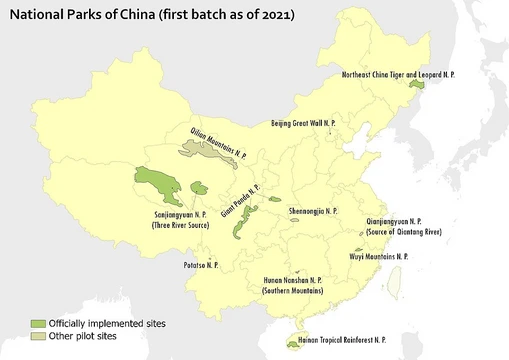
More in National parks of China 1-24
Spotted an error? Know more?
This is a living reference — every entry is fact-audited, and reader corrections feed straight into our audit queue. Suggest an edit · See this site's audit record