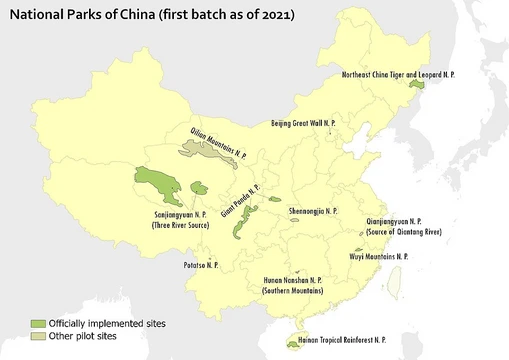
Northeast China Tiger and Leopard National Park
A Chinese national park protecting Siberian tigers and Amur leopards.

Northeast China Tiger and Leopard National Park is a protected area in northeastern China, spanning parts of Heilongjiang and Jilin Provinces in the southern Changbai Mountains. Established in 2017, it borders Russia and North Korea and is managed by a dedicated administration responsible for coordinating with provincial governments and protecting natural resources.
- location
- Heilongjiang and Jilin Provinces, China
- area
- 14,612 km² (5,642 sq mi)
- established
- 2017
- management
- Northeast China Tiger and Leopard National Park Administration
- habitat
- Coniferous and mixed broadleaf forest (9,483 km²)
- key_species
- Siberian tiger, Amur leopard, brown bear, Asiatic black bear, Eurasian lynx, sable, sika deer, red deer, red-crowned crane, golden eagle
Lore & Background
The park was launched in 2017 with a pilot phase initially managed by the National Forestry and Grassland Administration, but management was transferred the same year to the Northeast China Tiger and Leopard National Park Administration. This body coordinates with provincial governments and departments to safeguard the park's natural resources. During the pilot phase, industrial and mining enterprises in the area were closed, and fences, buildings, farms, livestock, and hunting gear were removed. Wild animals were rescued and released, feeding points for wildlife were established, and restoration of fragmented habitat was initiated.
Reader's Guide
Northeast China Tiger and Leopard National Park represents a significant conservation effort in northeastern China, covering over 14,600 square kilometers of the Changbai Mountains. Its establishment in 2017 marked a shift toward coordinated management of critical habitat for endangered species such as the Siberian tiger and Amur leopard. The park's coniferous and mixed broadleaf forests, spanning 9,483 square kilometers, support 355 vertebrate species, including brown bears, Asiatic black bears, Eurasian lynx, sable, sika deer, red deer, red-crowned cranes, and golden eagles. The pilot phase involved extensive remediation: closing industrial and mining operations, removing human-made structures and hunting gear, and actively rehabilitating wildlife through rescue, release, and feeding stations. By restoring fragmented habitats and eliminating threats, the park aims to sustain these populations. Its location bordering Russia and North Korea also positions it as a transboundary conservation area, complementing efforts like Russia's Land of the Leopard National Park. The park's administration continues to coordinate with provincial authorities to ensure long-term protection of its natural resources.
Did You Know?
- The park spans 14,612 km² in the southern Changbai Mountains.
- It borders both Russia and North Korea to the east.
- During the pilot phase, industrial and mining enterprises were closed and fences, buildings, farms, livestock, and hunting gear were removed.
- The park provides habitat for 355 vertebrate species, including the Siberian tiger and Amur leopard.
More in National parks of China 1-24
Spotted an error? Know more?
This is a living reference — every entry is fact-audited, and reader corrections feed straight into our audit queue. Suggest an edit · See this site's audit record